The Himalayas have never been just a mountain range. For so many years, they have been the home of the gods, the origin of the rivers, and the final destination of the souls that seek moksha or liberation. To tread these routes is to embark on a living holy book, where every mountain pass crossed is an answer to a prayer, every glacier a reflection of the infinite.
The Himalayas as Sacred Geography
Long before satellite mapping and trekking permits, the ancient rishis and wandering sadhus had already mapped the Himalayas in a much deeper way – as a spiritual topography where the lines between the human and the divine become impossibly thin. These mountains are not setting; they are subject. The cold, the height, the silence, the sheer scale – all of these work together to strip away everything that is not essential, leaving the seeker face to face with something they cannot name but cannot deny.
The routes covered in this book cover four of India’s most sacred pilgrimage routes and go all the way to the holiest mountain in the world. Whether you follow them on foot or trace them out on a map with reverence, they represent a window into one of the oldest and most enduring relationships between humanity and the sacred.
Kedarnath — Where Shiva Chose to Disappear
Altitude: 3,583 m (11,755 ft)
Trek distance: 16 km from Gaurikund (one way)
Best season: May–June, September–October
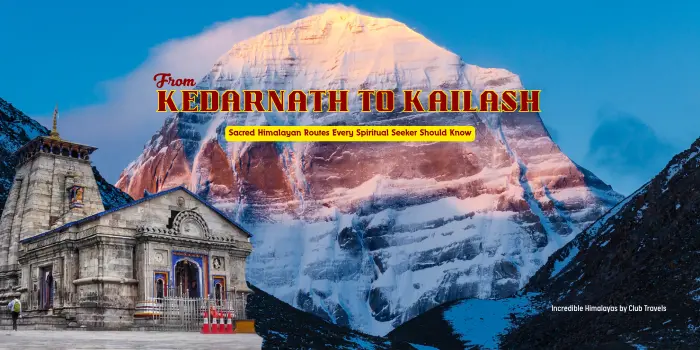
Located in the Garhwal Himalayas of Uttarakhand, Kedarnath is the most treacherous of the twelve Jyotirlingas , the manifestations of the infinite light of Shiva . In the legend, the Pandavas came here seeking Shiva to redeem themselves for the fratricide of the war of Mahabharata . Shiva did not want to be found, so he turned into a bull and knocked into the earth! The hump that is left over from his height blocks of earth becomes the linga worshipped here today .
The trek to Kedarnath is a pilgrimage upon pilgrimage. You walk past the bursting Mandakini River, thick clouds of rhododendron and the chanting of other pilgrims, as they pray Har Har Mahadev. As you finally see the stone temple against the stark landscape of the head of the Kedarnath peak and the glacier of Chorabari, there is a moment few of the pilgrims, regardless of faith , can miss and most just describe as a physical blow, a realization of something large.
What makes it special: Entropy is not kind there. Kedarnath will take something from you. The difficult terrain, the cold even in summer, the sound of glacier water constantly pounding below overwhelms the mind into a state of austere devotion that reflects the nature of Shiva, the destroyer, the ascetic, the one who sits with death.
2. The Char Dham Yatra — The Four Abodes of Heaven on Earth
The four dhams: Yamunotri, Gangotri, Kedarnath, Badrinath
Total circuit: Approximately 1,200 km by road, with dedicated treks to each shrine
Best season: May–June, September–October
The Char Dham circuit is the ultimate Hindu pilgrimage in the north of India – a holy circuit through the Garhwal Himalayas that follows the sources of the four holy rivers and binds the earthly abodes of the four major gods. It takes a lifetime of merit to complete the circuit, which is believed to cleanse the accumulated karma of many lifetimes.
Yamunotri is the source of the Yamuna, the river that is sacred to the grace of Krishna and the love of God made manifest. The journey takes one through gorges and hot springs where pilgrims cook rice as an offering – the mountain itself is the cook.
Gangotri is where the Ganga comes down from the heavens to the earth, snagged in the matted locks of Shiva to ease her fall. The temple is located close to the geological origin of the Bhagirathi, one of the major tributaries of the Ganges. For most devotees, merely touching the icy water here, which will flow thousands of miles to the sea, is sufficient.
Kedarnath and Badrinath complete the circuit. While Kedarnath represents Shiva, Badrinath is the winter home of Vishnu, nestled between the peaks of Nar and Narayan. The Alaknanda River swirls through the valley beneath the temple, and the hot springs of Tapt Kund beckon the worshiper to bathe before approaching the temple. The icon of Badrinarayan, Vishnu in meditation pose as a yogi, is a reminder to the worshiper that the sustainer of the universe is himself in meditation, paused in thought as he holds the entire universe in suspension.
What makes it sacred: The circuit is not an efficient route; it is not intended to be so. The distances between the sites, the mountain passes with precipitous drops, the unexpected storms — all of these are lessons to a worshiper that the journey is not about destination. It is about becoming someone who no longer needs to journey.
3. The Panch Kedar — Five Faces of Shiva in the Wilderness
The five shrines: Kedarnath, Tungnath, Rudranath, Madhyamaheshwar, Kalpeshwar
Best season: May–June, September–October
Difficulty: Moderate to challenging
While the Char Dham is a majestic circuit, the Panch Kedar is an initiation. After sinking into the earth at Kedarnath, the dismembered body of Shiva is believed to have re-emerged at four other spots in the Garhwal range. The five temples form the Panch Kedar, a journey that leads the pilgrim deep into some of the most unexplored regions of Uttarakhand.
Tungnath (3,680 m) is the highest Shiva temple in the world, a bare stone temple perched on a ridge beyond the tree line, where on a clear day one can glimpse both Kedarnath and Nanda Devi. Rudranath is lost in a thick forest of oak and rhododendron, a cozy temple where the face of Shiva is worshipped. Madhyamaheshwar lies close to the belly button of the holy bull, in meadows that explode into colors impossible to imagine during the short alpine summer. Kalpeshwar, reachable even in winter, houses the matted locks of Shiva and is known to fulfill the wishes of those who approach it with pure intentions.
What makes it sacred: The Panch Kedar is not an easy trek. There are no shortcuts or roads. Each of the temples showcases a different side of Lord Shiva – the fierce, the loving, the universal, and the personal – and collectively they present a complete picture of the great ascetic god.
4. The Valley of Flowers & Hemkund Sahib — Where Beauty Becomes Devotion
Location: Chamoli district, Uttarakhand
Altitude: Valley: 3,352–3,658 m | Hemkund: 4,329 m
Best season: July–September (valley), July–August (Hemkund)
The Valley of Flowers is a UNESCO World Heritage Site and one of the most extravagant displays of nature’s beauty – 500 species of wildflowers spreading over a glacial valley in the short, blissful period between monsoon and autumn snow. It is heaven for botanists and proof of the beauty of worship itself for spiritual seekers.
Hemkund Sahib, one of Sikhism’s holiest shrines, is a gurdwara situated on the shores of a glacial lake surrounded by seven peaks. Guru Gobind Singh, the tenth Sikh Guru, meditated here in a past life, as per the Dasam Granth. The lake mirrors the peaks in calm, silver water. Thousands of devotees trek here every year, with langar (community kitchen) serving all comers, irrespective of their religion.
What makes it sacred: The unique blend of natural beauty and strong devotion – Hindu devotees, Sikh devotees, and trekkers from all over the world sharing the same path, and each one finding what they sought.
5. Gangotri to Gaumukh — Walking to the Source of a Sacred River
Distance: 18 km from Gangotri to Gaumukh glacier
Altitude: 4,023 m at Gaumukh
Best season: May–June, September–October
The Ganga is more than a river in India. She is a mother, a goddess, a power of spiritual renewal so strong that Hindus have been bringing their dead to her shores for thousands of years. To make the trek to Gaumukh, the “cow’s mouth” of the Bhagirathi glacier from which she flows, is to follow the river back up to its most basic state.
The trek from Gangotri passes through pine forests and ancient ashrams, and then the junction at Chirbasa where the deodar cedars thin out and the high desert begins. At Gaumukh, a blue-grey torrent bursts out from under a wall of ancient ice, ice that is thousands of years old, glacial and icy cold, about to start a 2,525-kilometer journey to the Bay of Bengal.
Many devotees come here to bathe. The water is only slightly warmer than ice. It is not a comfortable experience. It is not about comfort. It is about touching something that has come from heaven to earth, and perhaps, just perhaps, being changed by that touch.
What makes it holy: You are at the source. The entire river, with all its ghats and burning cremation fires and festivals and prayers, starts here.
6. Kailash Mansarovar — The Ultimate Pilgrimage
Location: Tibet Autonomous Region, China
Altitude: Mount Kailash: 6,638 m | Lake Mansarovar: 4,590 m
Parikrama (circumambulation) distance: 52 km
Best season: May–September
Few journeys in the world demand respect from so many traditions as Kailash Mansarovar. Mount Kailash, never climbed, and never to be climbed, is the axis mundi of at least four traditions: the earthly abode of Shiva for Hindus, the paradise of Demchog for Tibetan Buddhists, the throne of the first tirthankara Rishabhanatha for Jains, and the place of Kangri Rinpoche for Bönpos. It is the mountain at the center of the world.
The journey from India crosses the high desert, over the dramatic topography of the Tibetan plateau, until Kailash comes into view – a flawless, glacier-capped pyramid, its southern face shining, its peak eternally shrouded in cloud. The mountain does not just come into view; it makes its presence known. Devotees have wept at first sight. Experienced trekkers have reported going mute for minutes on end.
The parikrama, or circumambulation of the mountain, takes three days and includes crossing the Dolma La pass at 5,636 m, one of the highest trekking passes in the world. Tibetan pilgrims may make the journey around the mountain by prostrating themselves the entire way, measuring the mountain in their own body length, a journey that takes weeks. At Lake Mansarovar, said to be created by Brahma and lapped by the sun before any other body of water each morning, pilgrims bathe in water of breathtaking clarity and cold.
What makes it sacred: Kailash is not a place you go to and get done with. Pilgrims of all faiths have described it as a place that changes you — not figuratively, but actually, in the way you move through the world afterwards, in what you find you can no longer care about, in what suddenly is enough. The mountain provides nothing. That, somehow, is enough.
Planning Your Sacred Journey: Practical Wisdom
Physical Conditioning
Altitude sickness is the great equalizer—it does not care about fitness levels or dedication. Acclimatize, climb slowly above 3,000 m, and never underestimate the symptoms. The mountains will still be there when you get back. Your body won’t be as lenient.
The Best Time to Visit
The best time to visit is from May to June and September to October. The monsoon season (July to August) is beautiful but also prone to landslides and leeches. Winter shuts down most temples. Kailash is open only from May to September.
Permits and Rules
The Kailash Mansarovar Yatra requires permits from both the Indian and Chinese governments, and the Indian government has an official yatra program that regulates the flow of visitors. Inner Line Permits are required for some routes in Uttarakhand and Himachal Pradesh.
What to Bring, What to Forgo
Practical things: layers of clothing, a good rain poncho, trekking boots, a headlamp, and simple altitude medication (consult a doctor about Diamox). What to forgo is much more difficult to enumerate: expectations, time constraints, the urge to record every detail, the need to arrive. The people who seem to get the most out of these mountains are those who bring the least of themselves.
Common Questions
Everything you need to know before you go.
Can’t find your answer? Email us at clubtravels@gmail.com — we respond within one business day.
Not at all. Our pilgrims hail from every religious background—and many of them have no religious affiliation at all. The Himalayas are a generous spiritual source. Holy sites such as Hemkund Sahib are open to Sikhs and non-Sikhs alike; Mount Kailash is a holy site for Hindus, Buddhists, Jains, and Bönpas. We only ask for respect and an open mind, not your conversion. Our guides will brief you on the cultural context so you can participate fully without obligation.
It varies depending on the trek. Kedarnath and Valley of Flowers are doable for people with moderate fitness levels—if you can walk 10-15 km a day, you’re good to go with proper acclimatization. The Panch Kedar and Kailash Mansarovar treks demand strong cardiovascular endurance—you’ll be trekking at high altitudes for several days in a row. We have acclimatization days in every itinerary, and our medical staff checks on everyone every day. Horse/helicopter options are available for parts of several treks for those who need them.
The Kailash Mansarovar Yatra requires Indian and Chinese/Tibetan permits, which need to be applied for months in advance. We process the entire permit procedure for all nationalities, including Chinese Group Tourist Visas, Tibet Travel Permits, Alien Travel Permits, and Military Area Permits. We also process the Indian government’s official Yatra program, if applicable. Begin your application process at least 6 months prior to your desired departure date.
Altitude sickness (Acute Mountain Sickness) results from rapid ascent above 2,500 m, before the body can adapt to the lower oxygen levels. Symptoms include headaches, nausea, fatigue, and dizziness. Every Sacred Himalayas tour includes: mandatory acclimatization days, daily pulse oximeter monitoring, certified wilderness medics, oxygen available, and Diamox on request (consult your doctor first). We never rush the ascent. Any serious symptoms in a participant send them down immediately – your life is more valuable than the completion of the pilgrimage.
The best season to visit Kedarnath is from May to early November. The best periods are May-June (pre-monsoon season) and September-October (post-monsoon season). May-June provides a clear climate, moderate temperatures, and the thrill of the opening of the season. September-October provides a clear blue sky, snow-capped mountains, and fewer trekkers. The monsoon season (July-August) should be avoided, except if you are trekking to Valley of Flowers, which is in full bloom during this time. The temple closes for winter in October/November and opens in April/May.
Our tour prices include: airport pickup and drop-off in Delhi/Dehradun, all accommodations (lodges, guesthouses, tents), all meals on trek, qualified English-speaking guide, support staff and porters, all permits and entry fees, altitude medical kit and medic, local SIM card, and 24/7 WhatsApp support. Not included are: international flights, travel insurance (mandatory), personal trekking equipment, tips for staff, and upgrades.
Yes. Many of our pilgrims are solo women travelers from all over the world, and their safety and comfort are a primary concern. Our groups are always accompanied by at least one female guide or liaison, and our staff are instructed on proper behavior. The pilgrimage routes in Uttarakhand are well-trodden and relatively safe. We can match solo women travelers with a same-sex group or arrange female-only accommodations if requested. We invite you to view the solo women traveler testimonials on our website.
Yes. Many of our pilgrims combine the Char Dham circuit with an extension to Panch Kedar, or precede Kailash with a visit to Kedarnath for acclimatization. We will create customized multi-route circuits to suit your time, physical ability, and spiritual interests. Our 30-day “Grand Himalayan Pilgrimage” combines Kedarnath, Badrinath, Valley of Flowers, and Kailash for the ultimate Himalayan experience.